
NFC West Resource Allocation
Boasting the defending Super Bowl Champions, the NFC West may be the best - and most fascinating division in football.

This is the fourth piece in a nine-week project, and it finishes the conference. Each week I take one division, build a single comparable resource value for every player on every projected 53-man roster, and lay out what the numbers describe. The NFC North gave us a clear laggard in the Vikings. The NFC South gave us a thrifty division and a cheap-quarterback bet in New Orleans. The NFC East gave us four teams in an arms race when it comes to resources. The NFC West gives us something none of the others did. It gives us the two extremes of roster building, in the same division, at the same time.
The NFC West is unique in that it incorporates the entire spectrum of team-building strategies within a division widely considered the most competitive in football. Imitation may be the sincerest form of flattery, but in the NFC West differentiation breeds hyper competitiveness.
The methodology gets a full treatment in the intro piece, but the tl;dr is the same every week. I look at actual cash spending for my best guess at the opening-day 53-man roster for each team using Ourlads depth charts. Cash is more important than cap accounting because it addresses real investments in the on-field product. Then I layer in draft resource allocation through my own pick valuation chart, which uses the NFL salary cap to assign a financial value to every pick rather than a points system. That creates one currency for cash and draft capital, and it lets us see the whole picture instead of half of it.
Imitation may be the sincerest form of flattery, but in the NFC West differentiation breeds hyper competitiveness.
The NFC West From 10,000 Feet
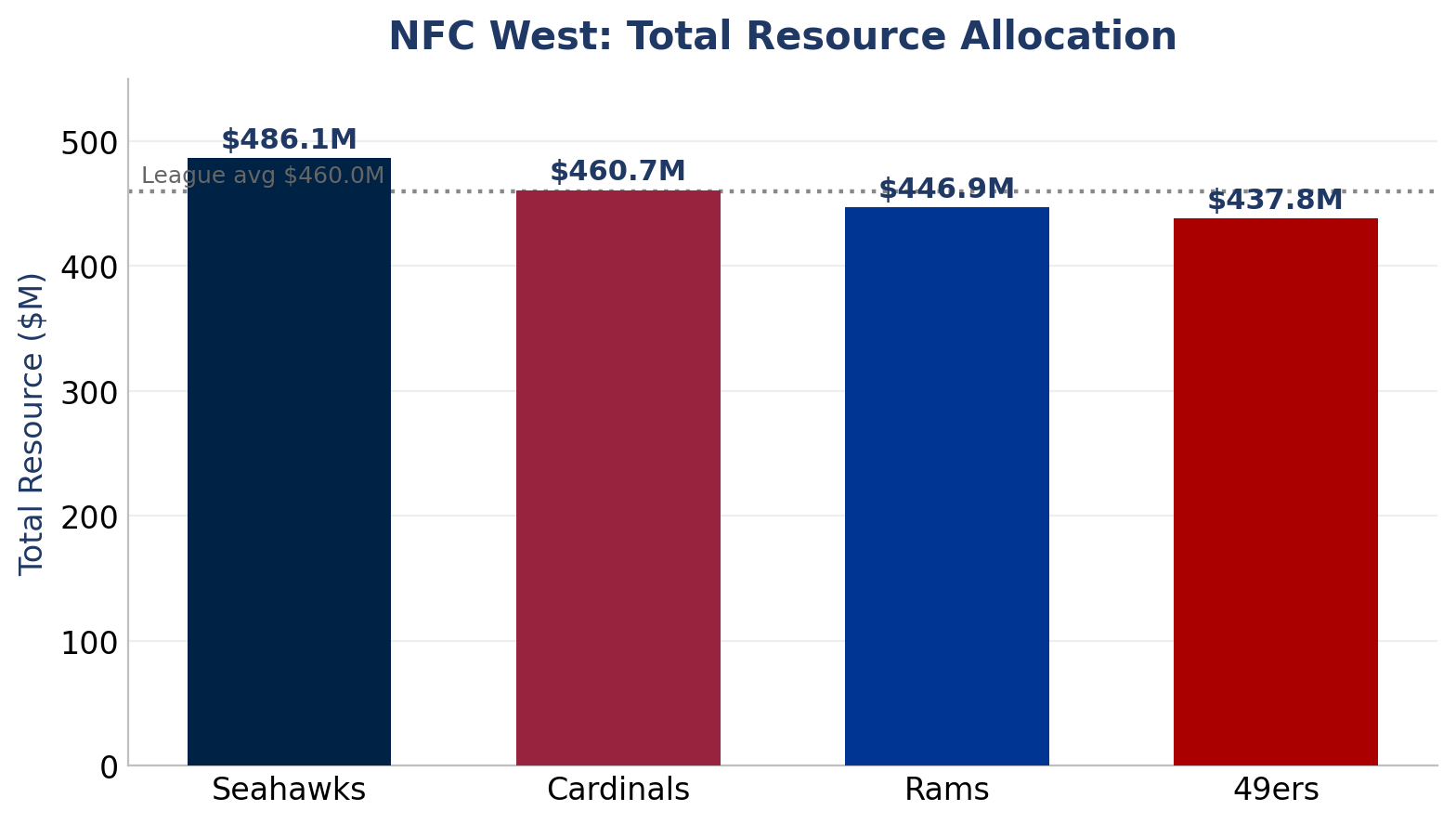
The Seahawks are investing like a team that just won the Super Bowl and feel like they can keep their window open for the foreseeable future. They are leading a closely aligned division in total resource allocation.
But the team that ranks second in the division is not the one you, I, or anyone would expect. The Cardinals’ robust allocation is based heavily on their league-leading draft capital investment. Stockpile enough early round picks and the investment picture becomes substantial.
The Rams have transformed from one of the lowest spending teams in the NFL in terms of cash over the past several years to one who is sinking real cash investments. They are the most eager team in the league to trade away premium draft picks for proven veteran talent (see Garrett, Myles trade). Because of that they wind up on the lower side of resource investments year over year. That only strengthens the case for Les Snead, Sean McVay and the Rams’ brain trust being one of, if not the best, in the league. And you know what? I believe it.
The 49ers are playing the same song as the Rams, with slightly fewer notes.
Asset Allocation By Type
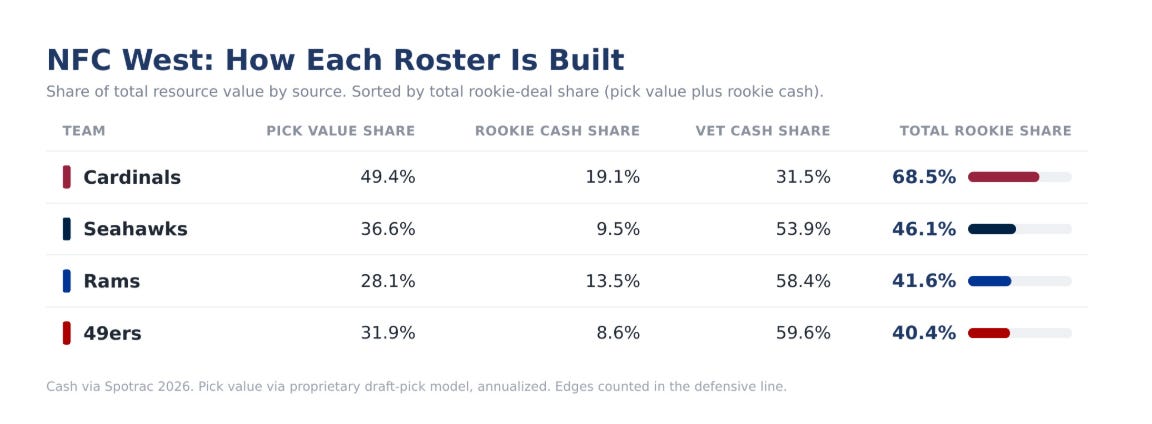
This is where the division earns its billing. The two most opposite team-building approaches in the entire league are sitting right next to each other.
Arizona is the most draft-heavy team in the conference. Of every dollar of resource value on the projected 53, 49.4 cents corresponds to a rookie’s draft pick. That is the highest rookie share I have measured across four divisions, and it is not an accident. The Cardinals are resetting. They own the most draft capital in the league at $227.8 million in pick value, and it shows up everywhere on the roster.
The Rams are the mirror image and then some. At 28.1 percent rookie share, Los Angeles is the most veteran-built team I have measured, thus far. Their draft capital is the lowest of any team in the NFC. They have shipped picks out for years to keep a championship window open, and the bill for that shows up as a roster almost entirely made of players who have already been paid.
San Francisco (31.9 percent) and Seattle (36.6 percent) live in between, but they get there differently. The 49ers are veteran at the very top and cheap everywhere else. The Seahawks are the rare team carrying real money and real draft capital at the same time, which is exactly why they show up with the largest investment in the division as they look to defend their Super Bowl title.
***At 28.1 percent rookie share, Los Angeles is the most veteran-built team I have measured, thus far.***
The two most opposite team-building approaches in the entire league are sitting right next to each other.
Cash vs. Draft Capital, Team by Team
The total tells you the commitment. The shape tells you the philosophy. Each team gets two radars on the same scale, one for 2026 cash, one for annualized draft capital. The cash radars look broadly alike across the league, large at the lines and somewhere in the secondary. The draft radars are where front offices diverge.
Arizona Cardinals
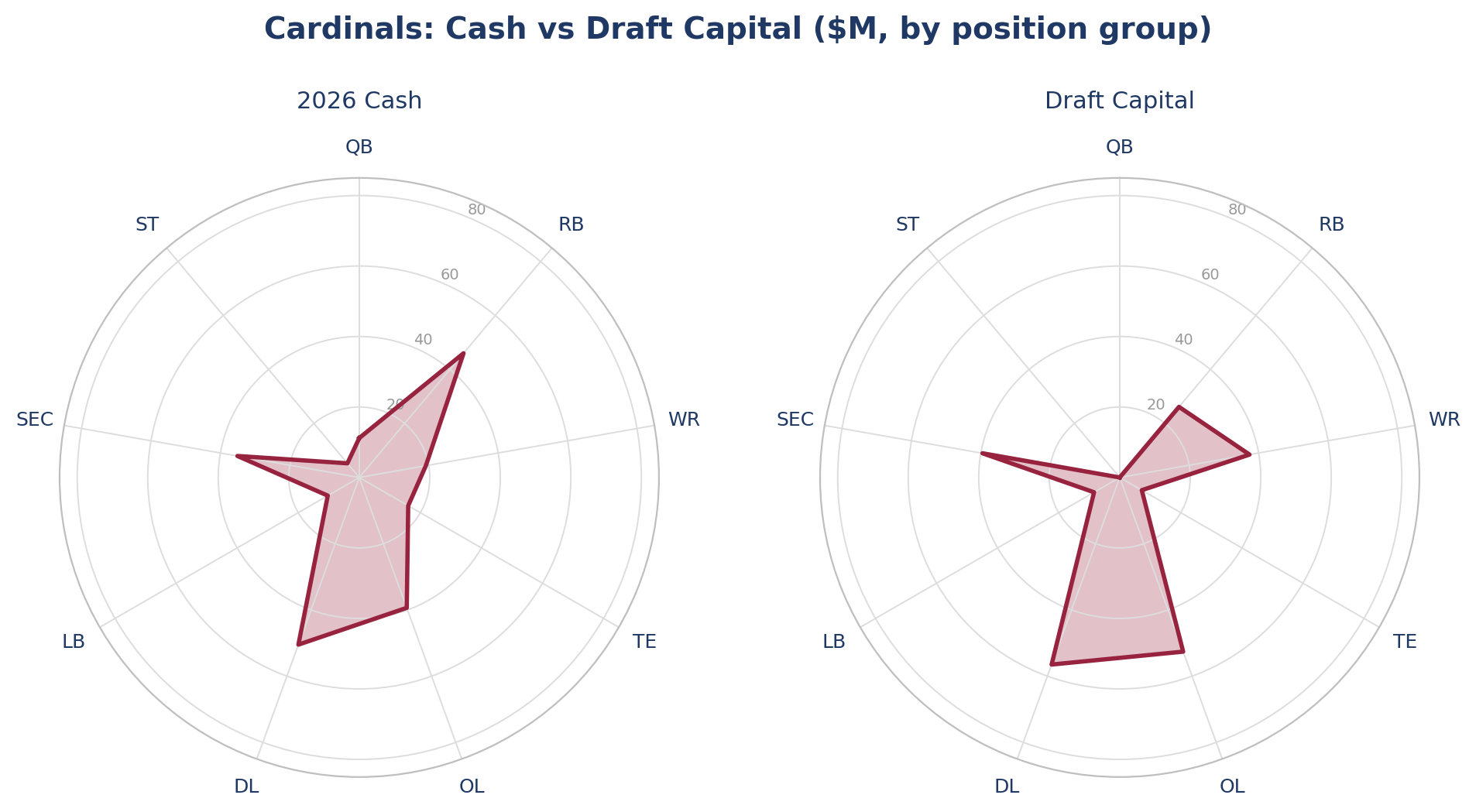
The Cardinals’ radars look similar in shape, but different in magnitude. Spikes near $40 million for the secondary. Large investments in both lines. Arizona is building their receiver room through the draft. The running back room is being similarly developed, although it looks like a big cash investment because of the large signing bonus they are paying to rookie Jeremiah Love.
Los Angeles Rams
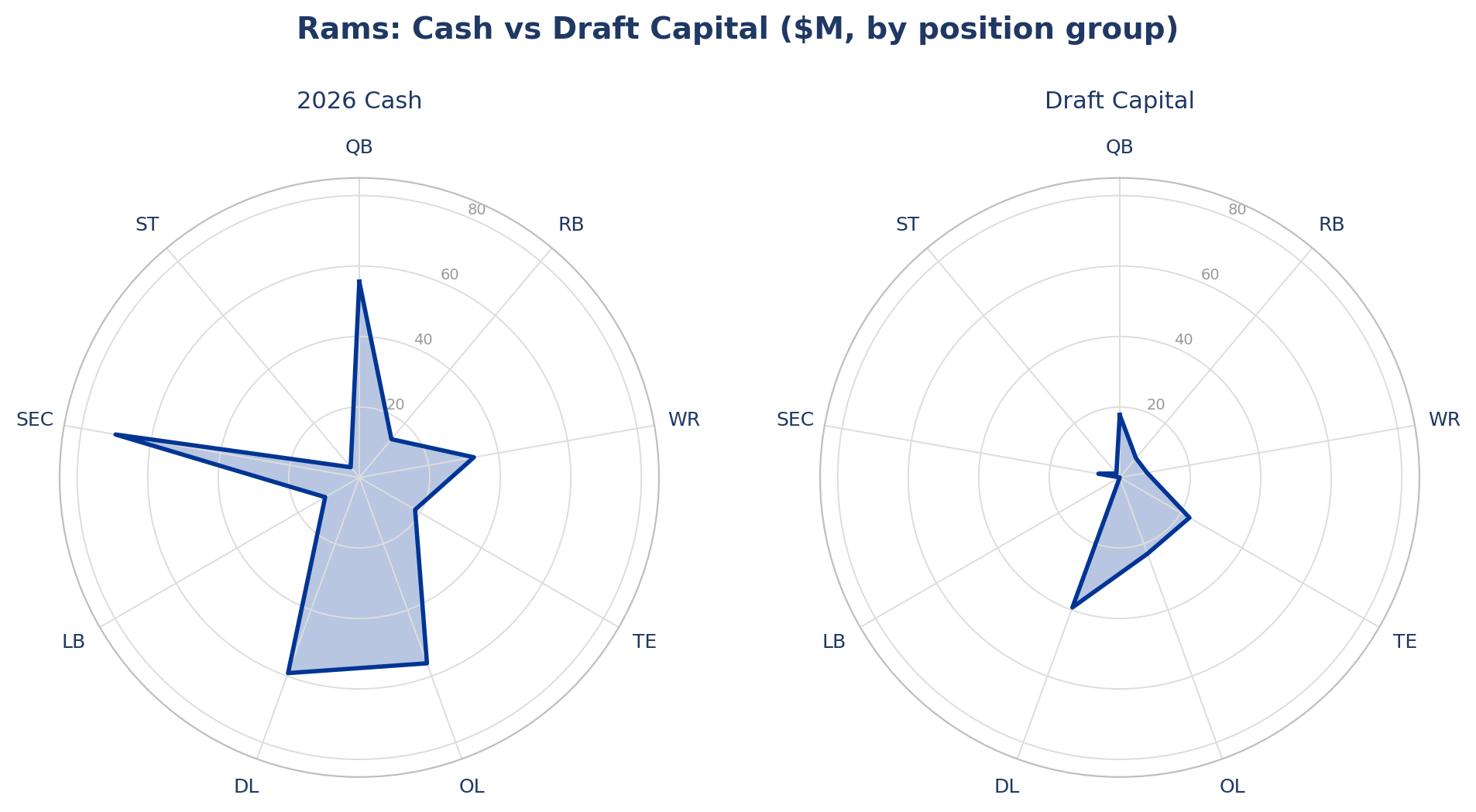
The Rams are the inverse, and it is stark. The cash radar is full and balanced, large at quarterback, the defensive line, the secondary, the offensive line, and receiver. The draft radar is nearly empty, the smallest in the division. Los Angeles has spent its picks and is paying cash for veterans at every level. Matthew Stafford anchors it, the Myles Garrett and Trent McDuffie trades headline it, and a secondary bought almost entirely with veteran money fills it in. This is a win-now radar with no future capital behind it, which is a choice, and a defensible one if the window is open now.
San Francisco 49ers
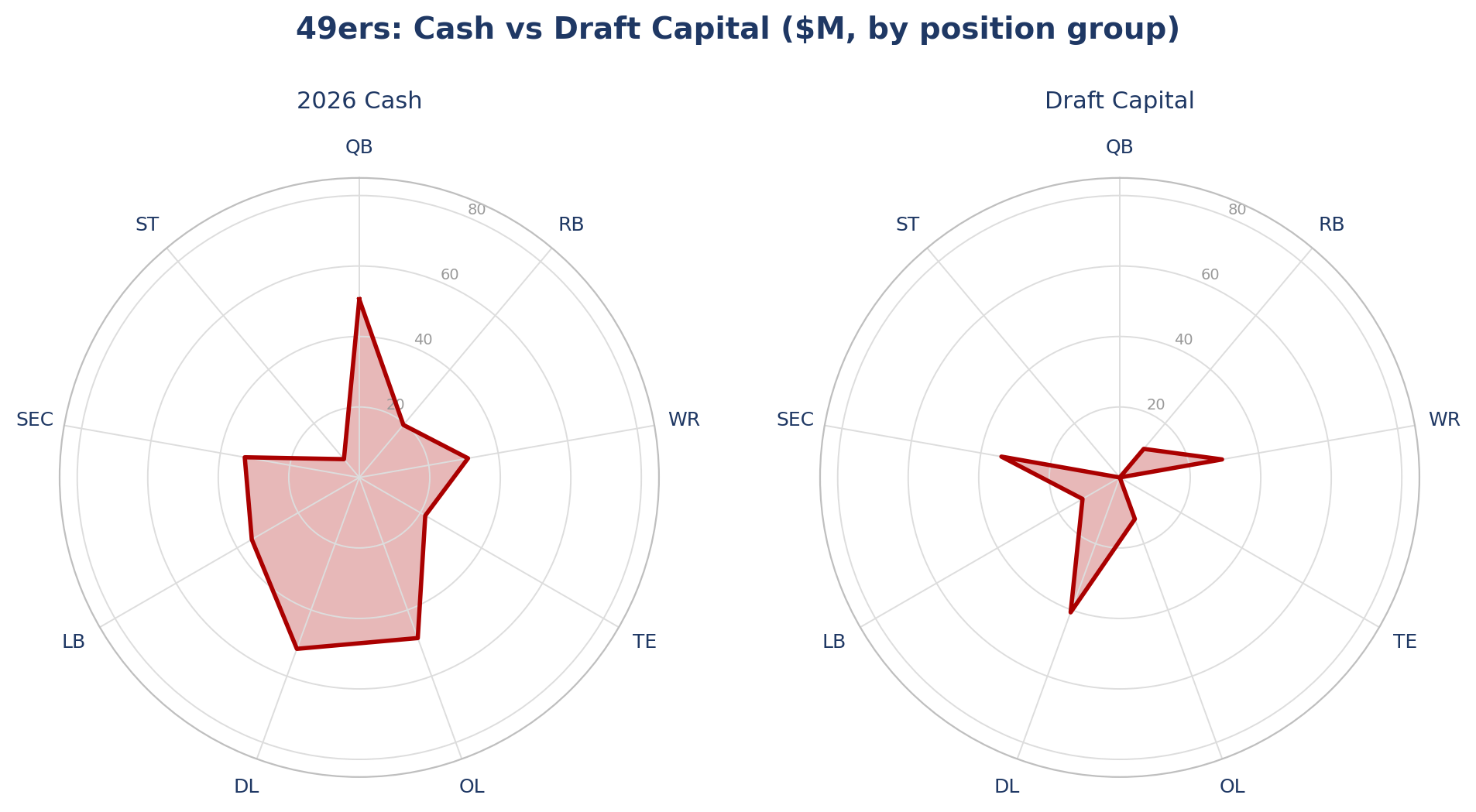
San Francisco’s cash radar has four enormous spikes and not much else. Quarterback, offensive line, the defensive line, and off-ball linebacker tower over the rest because of four specific contracts, with the rest of the roster running cheap and young. The draft radar is moderate and tilts toward the receiver and secondary rooms they keep restocking on Day 2. This is the megadeal model; a handful of premium players paid at the very top of the market with cost-controlled depth around them.
Seattle Seahawks
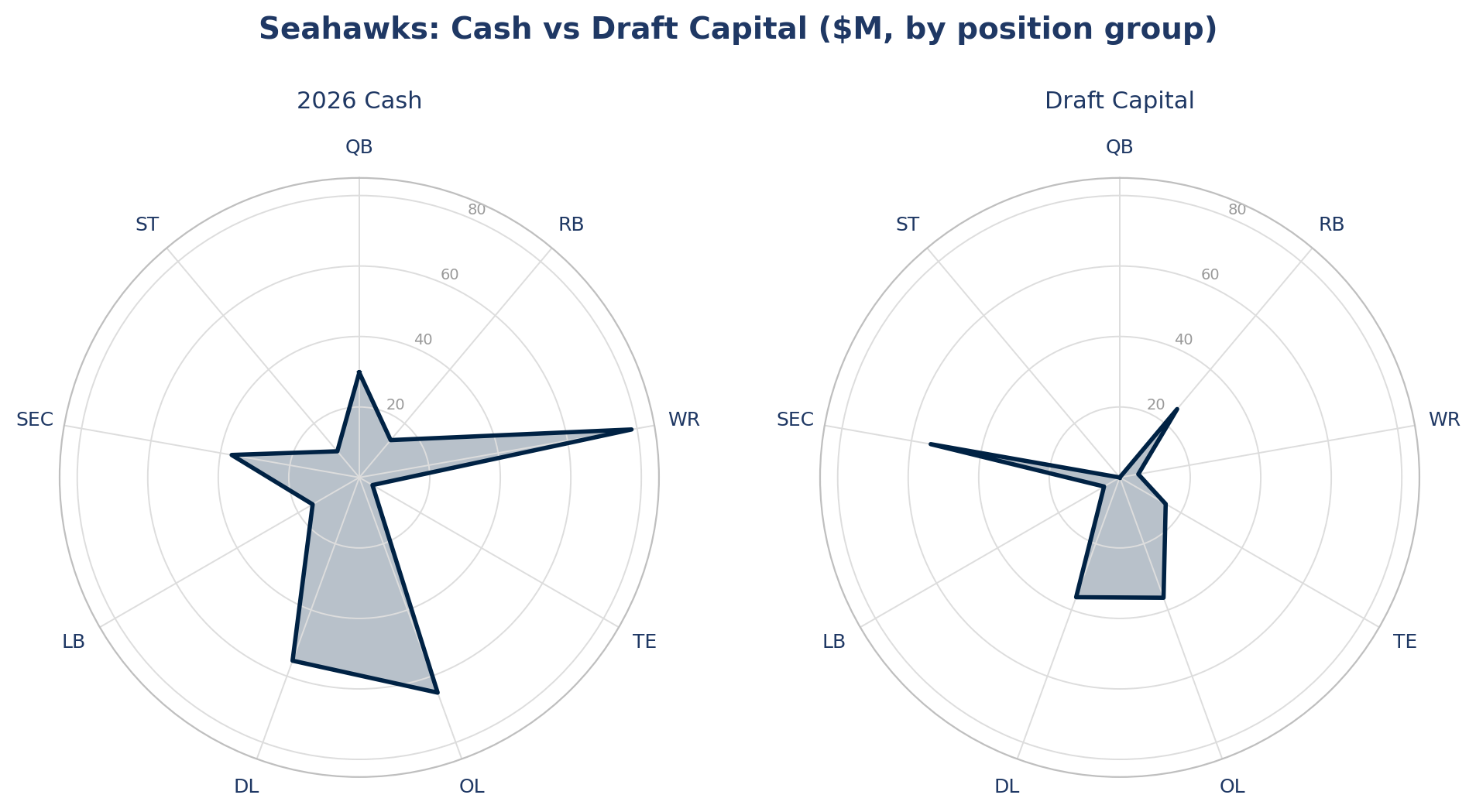
Seattle’s radars are the healthiest in the division because both of them are full. The cash radar leans receiver and offensive line, where Jaxon Smith-Njigba and Charles Cross carry premium deals. The draft radar leans secondary, defensive line, and running back, where Devon Witherspoon, the front, and a rookie back carry real pick value. Carrying this much in both currencies at once is hard, and it is why the Seahawks are the only team in this division that ranks among the league’s most-resourced rosters.
Where The Money Actually Goes
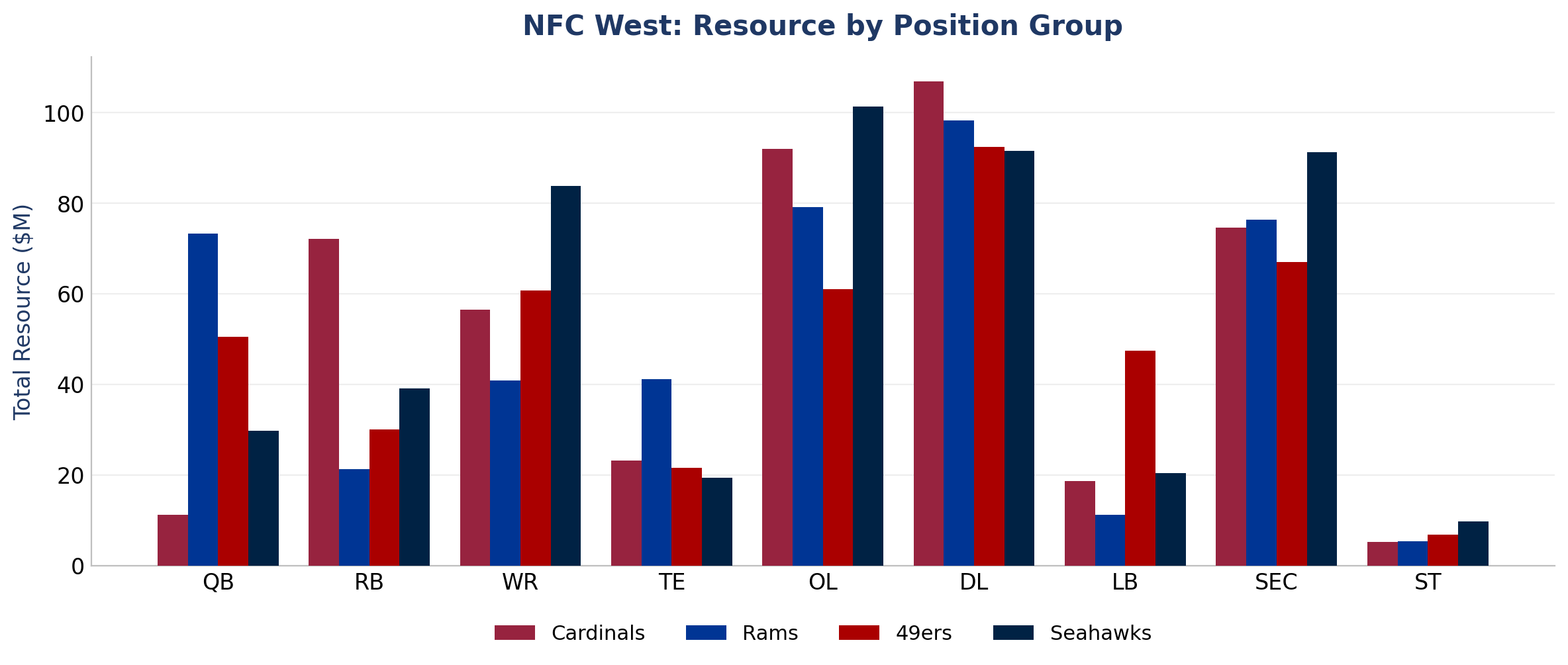
Some trends remain constant from division to division. Much like the rest of the NFC, trench play gets paid. It’s partly due to the philosophical canon that protecting and getting after the passer are critical to team success. But it’s also because nine of 25 starters (counting specialists) come from these two position groups.
But there are some interesting positional deviations within the NFC West. The Cardinals not having a premium veteran or a significant draft asset invested in quarterback is certainly interesting. *
The 49ers’ investment in Fred Warner is equally fascinating. But to me, watching the Seahawks put the same investment into their secondary as their defensive line is the most fun to watch bear out on the field as their defense has taken the NFL by storm.
*Arizona still has significant resources tied up in quarterback, but it doesn’t show up in their on-field product. After cutting Kyler Murray in the offseason, they still owe him over $36 million in cash this year. That cash outflow does not show up in this analysis, but I wanted to note it as it is important when considering that teams have total cash budgets they work within and Murray’s is almost certainly impacting Arizona’s efforts to spend elsewhere.*
Quarterback
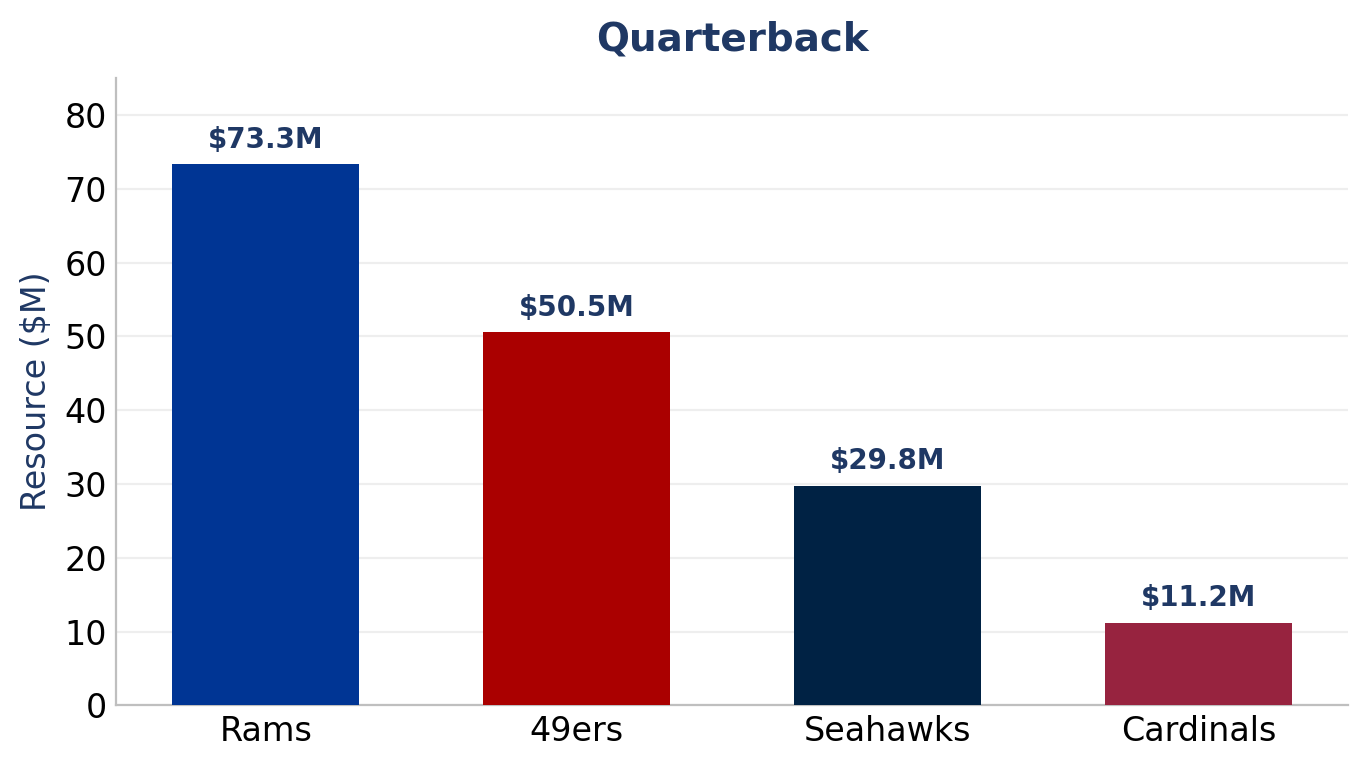
Four teams, and the widest quarterback gap in any division so far.
Los Angeles ($73.3M) leads, and it is building for now and later at once. Matthew Stafford is on $40 million in cash, and behind him sits Ty Simpson, a first-round rookie carrying $33.3 million in combined resources as the heir apparent. The Rams are paying for the present and drafting the succession plan in the same room.
San Francisco ($50.5M) is all Brock Purdy, whose $47 million cash hit is the bill that comes due when a late-round quarterback turns into a franchise one. The bargain is over. The 49ers are paying market rate now.
Seattle ($29.8M) runs Sam Darnold at $27.5 million on a reasonable veteran deal, the kind of cost-effective bridge that lets the Seahawks spend big elsewhere.
Arizona ($11.2M) is the cheapest quarterback room in the league, and it is the engine of the entire rebuild. The room is Gardner Minshew and Jacoby Brissett on minimal deals.
The Rams are paying for the present and drafting the succession plan in the same room.
Running Back
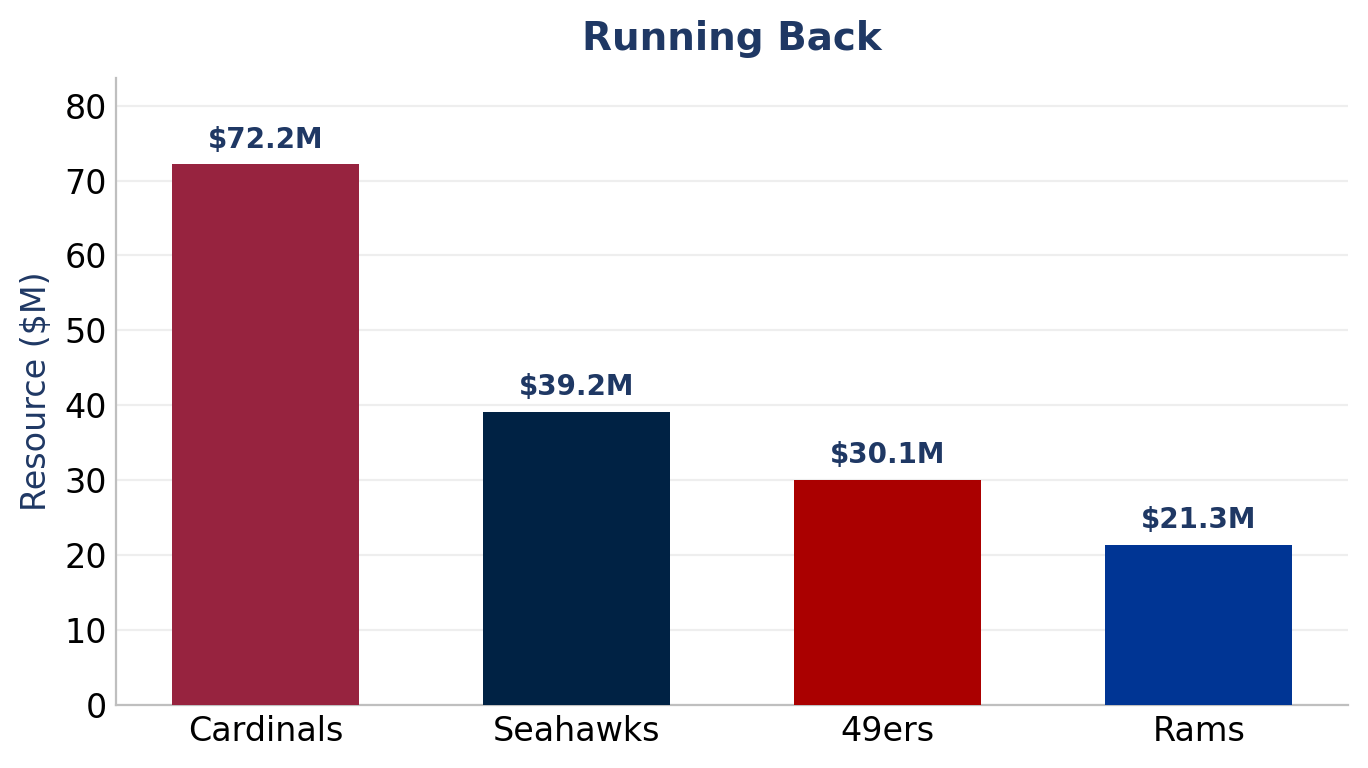
Arizona ($72.2M) leads the division and the entire league, and it is almost entirely one player. Jeremiah Love, a projected first-round pick, carries $62.1 million in combined resources, driven by a large rookie signing bonus that hits the cash books in year one. It is real money out the door now, even if it spikes the position for a single season. Tyler Allgeier and James Conner round out the room. No other backfield in the division comes close.
Seattle ($39.2M) is next, pairing rookie back Jadarian Price with Zach Charbonnet. San Francisco ($30.1M) runs through Christian McCaffrey’s $12.5 million and cheap young legs behind him.
Los Angeles ($21.3M) is the lowest, which fits. Kyren Williams on a modest veteran number and Blake Corum on a rookie deal give the Rams a productive backfield without a real bill, exactly the kind of efficiency a cash-strapped contender needs at a devalued position.
Wide Receiver
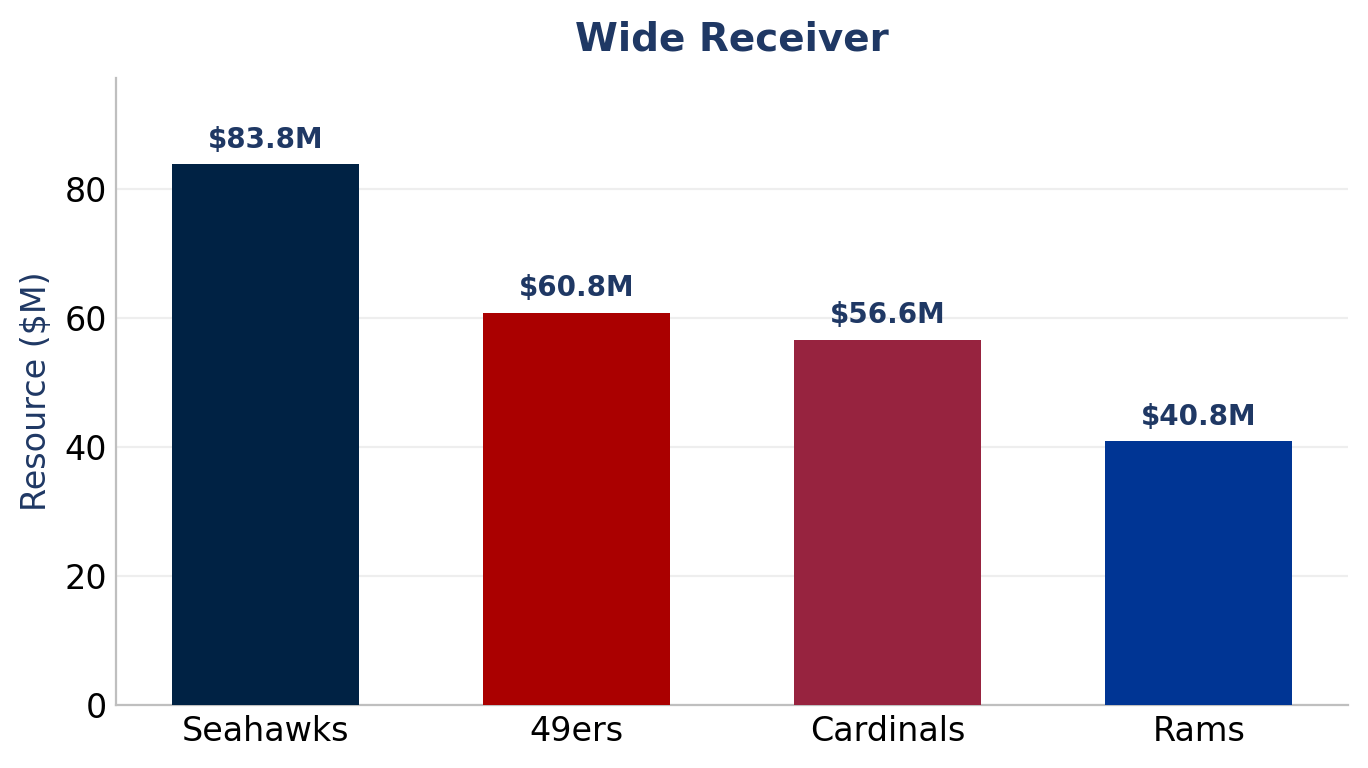
Seattle towers over the division and ranks among the most expensive receiver rooms in football. Jaxon Smith-Njigba’s extension is leading the way for a division that isn’t paying big cash for the position. That’s an intriguing distinction from the rest of the NFC. The Seahawks doubled down by stacking Rashid Shaheed and Cooper Kupp on top of it. This is the clearest single statement of intent on the roster.
San Francisco ($60.8M) is built differently, blending veteran Mike Evans with Ricky Pearsall’s first-round rookie value and a second receiver on the way in De’Zhaun Stribling. Arizona ($56.6M) runs through Marvin Harrison Jr.’s $28.5 million in rookie value, with cheap veterans behind him.
Los Angeles ($40.8M) is the lowest, and it is the single best illustration of the Rams’ whole approach. Davante Adams is paid $24 million in cash. Puka Nacua, a top-ten receiver in football, is still on a rookie deal at $8.6 million. The Rams are getting a premium room for a mid-tier price because half of it has not been paid yet, which is the one place their cheap-draft-capital approach actually saves them money instead of costing it.
Tight End
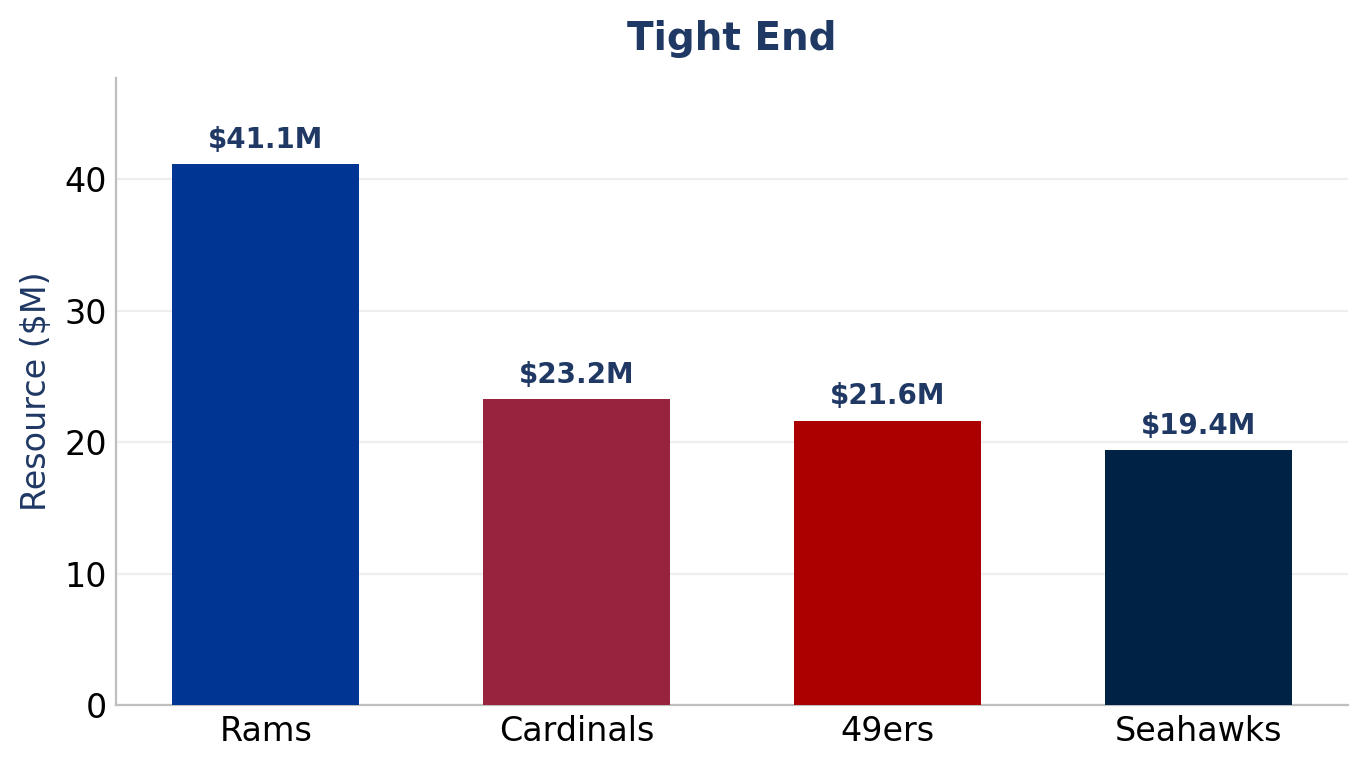
The Rams are saving on wide receivers, in part, because of a strategic investment in tight ends. After going from almost no 13 personnel in 2024, the Rams became the tight end heaviest team in the NFL in 2025. This is the first team to outspend the Bears at tight end.
The Cardinals and 49ers are each paying a premier tight end in Trey McBride and George Kittle. Between the West and the NFC North, we may be in a golden age of tight ends.
Offensive Line
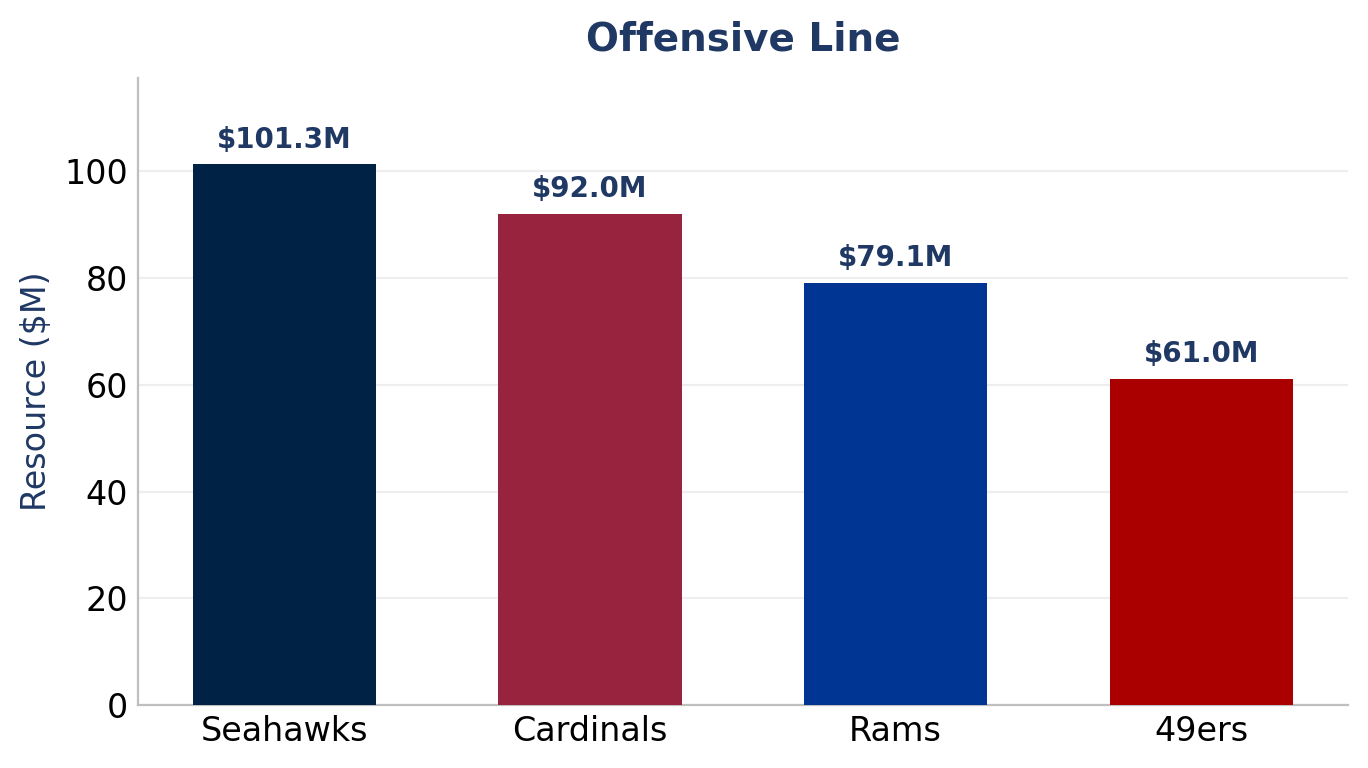
Seattle ($101.3M) leads the division and posts one of the heaviest offensive line numbers in the league, anchored by Charles Cross’s $43.1 million and first-round rookie Grey Zabel’s pick value. The Seahawks have decided the line is where the cash goes.
Arizona ($92.0M) is next, with Paris Johnson Jr.’s rookie value and another first-round-caliber rookie in Chase Bisontis leading a young, ascending unit. Los Angeles ($79.1M) pays veterans Alaric Jackson, Kevin Dotson, and Steve Avila.
San Francisco ($61.0M) is the lowest by a wide margin, and it is a one-man story. Trent Williams’ $24.5 million is nearly half the room, with cheap and rookie-deal pieces around him. The 49ers are betting an aging superstar tackle, cost-controlled youth, and an offensive mind that has schemed around talent deficiencies for years can hold a line together. It is the riskiest trench bet in the division.
Defensive Line
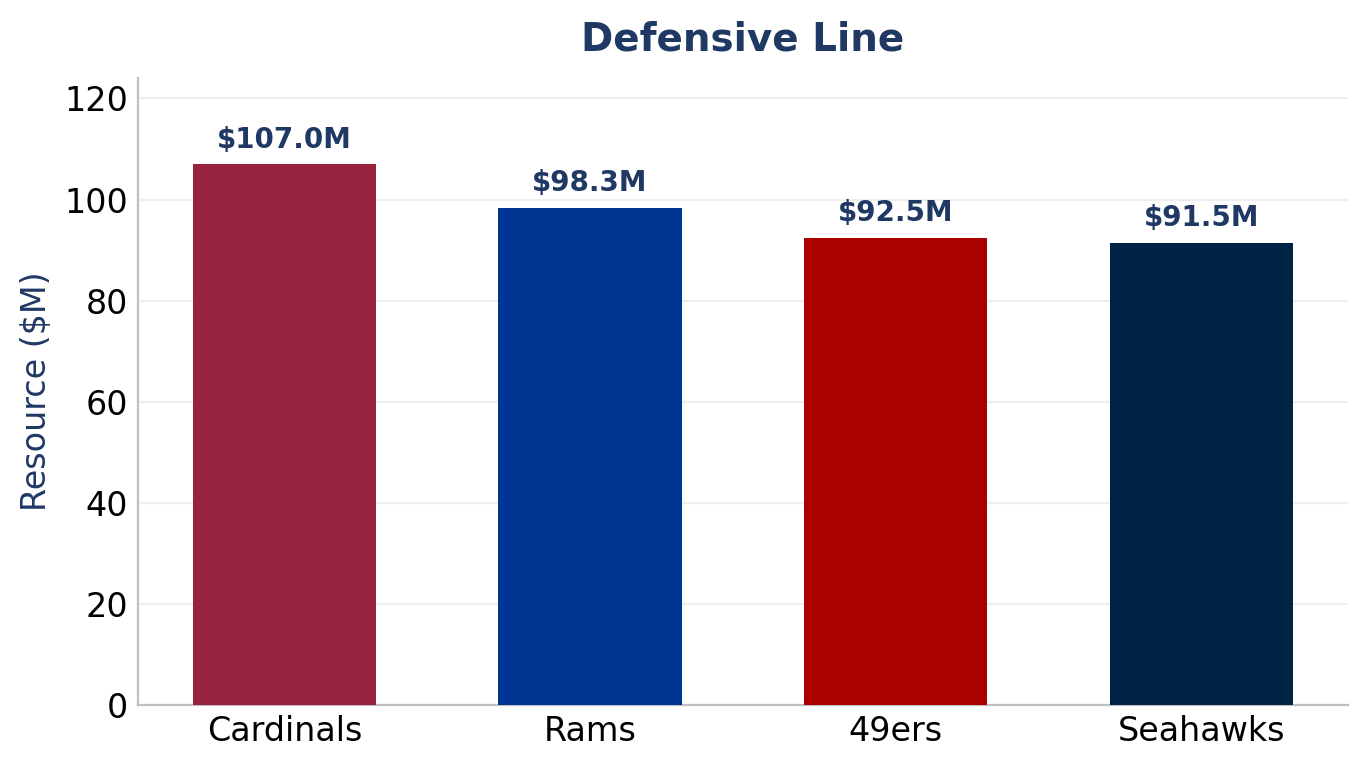
The largest investment for every team in the division, as always, and the four teams are bunched tightly between $91.5 million and $107 million.
Arizona ($107.0M) leads, and it is the young centerpiece of the rebuild. Walter Nolen and Darius Robinson on rookie value, Josh Sweat and BJ Ojulari on the edge. The Cardinals are building their identity up front. But for all the investments, they are probably the least potent line of the bunch.
Los Angeles ($98.3M) is the Myles Garrett show. The blockbuster trade brought the reigning Defensive Player of the Year edge rusher to a roster already carrying Braden Fiske and Kobie Turner on rookie deals. It is the single biggest swing in the division, and it is the clearest sign of how far the Rams will go to win now.
San Francisco ($92.5M) runs through Nick Bosa’s $23.2 million and a stack of young interior talent in Mykel Williams and Alfred Collins, plus the traded-in Osa Odighizuwa. Seattle ($91.5M) pairs Byron Murphy II’s rookie value and Leonard Williams with a deep edge rotation. Four heavy fronts, four different ways of getting there.
Linebacker
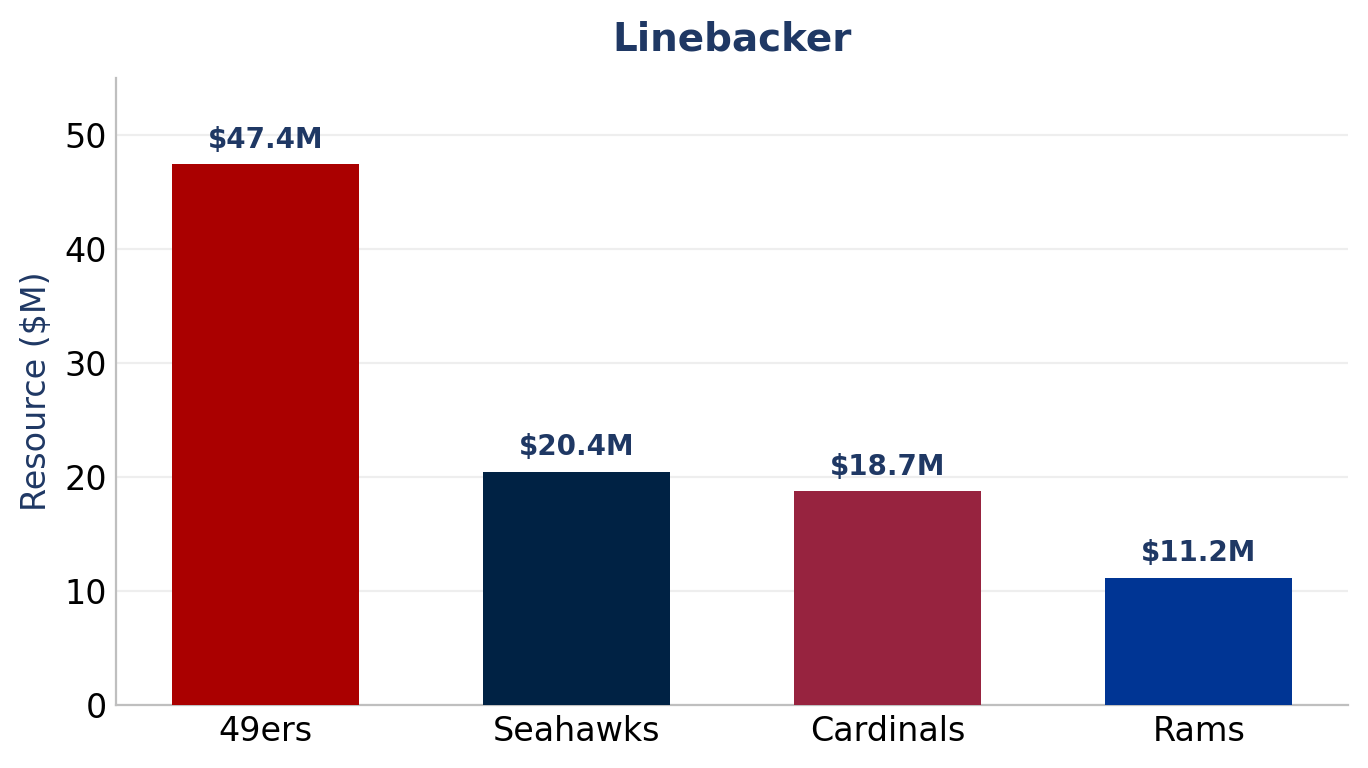
San Francisco ($47.4M) spends more than twice any other team in the division here, and it is Fred Warner. His $23.2 million is the premier off-ball linebacker contract in football, and Dre Greenlaw and rookie Nick Martin fill in behind him. The 49ers are the rare team that pays the position like it matters, because they have the rare player who justifies it.
Seattle ($20.4M) runs through Ernest Jones IV. Arizona ($18.7M) is cheap and young. Los Angeles ($11.2M) is the lowest in the division, Nate Landman and scraps, because every available dollar went to the line and the secondary.
"The 49ers are the rare team that pays the position like it matters, because they have the rare player who justifies it."
Secondary
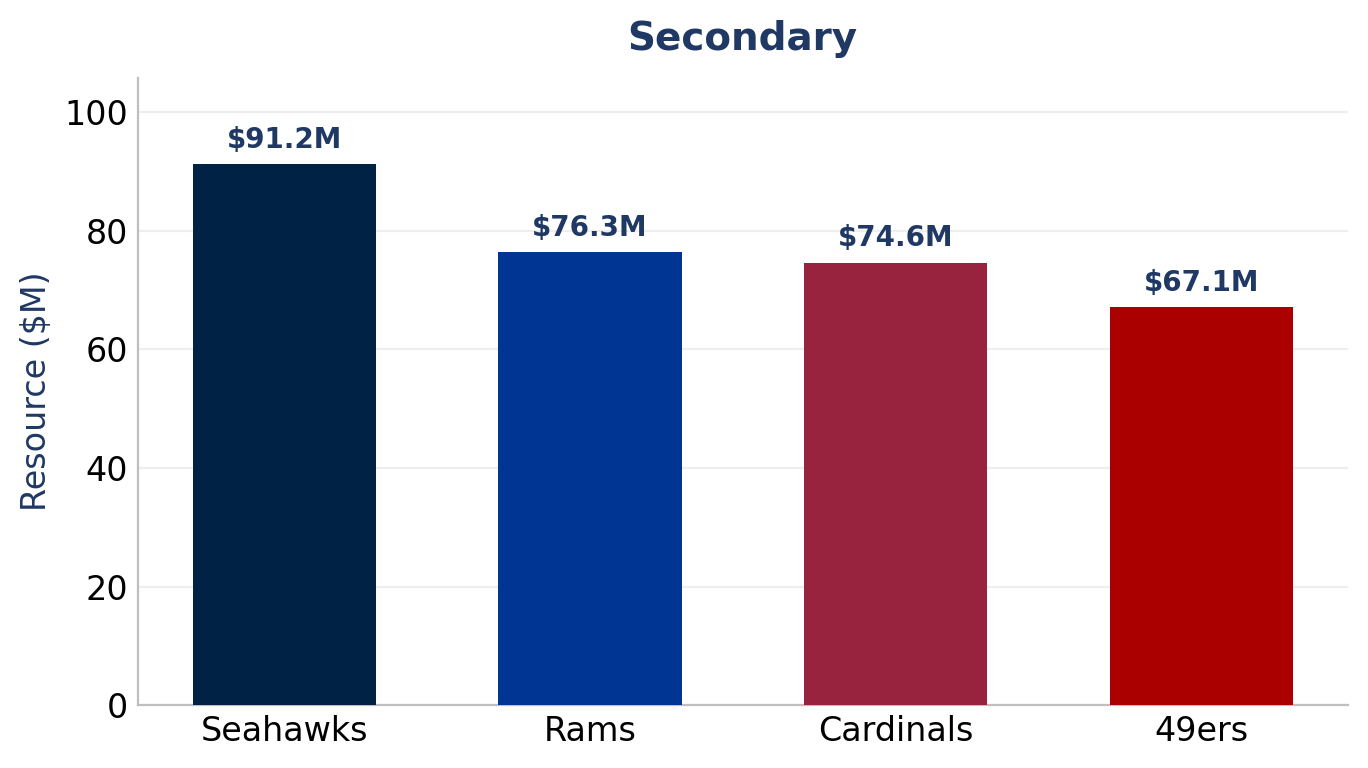
Seattle ($91.2M) leads, and it does it the smart way. Devon Witherspoon carries $28.3 million in resources, almost all of it rookie value, with Nick Emmanwori and Julian Love around him. The Seahawks have a top-end secondary that has barely started paying for it.
Los Angeles ($76.3M) bought theirs in cash. Trent McDuffie, acquired by trade, plus Jaylen Watson, Quentin Lake, and Kam Curl give the Rams a veteran-priced unit with almost no rookie value in it, $70.2 million of the $76.3 million in straight cash. Arizona ($74.6M) is the opposite again, young and cheap with Budda Baker the lone veteran anchor over a stack of rookie-deal corners in Will Johnson, Max Melton, and Garrett Williams. San Francisco ($67.1M) is the lowest, Deommodore Lenoir leading a mostly young group.
Special Teams
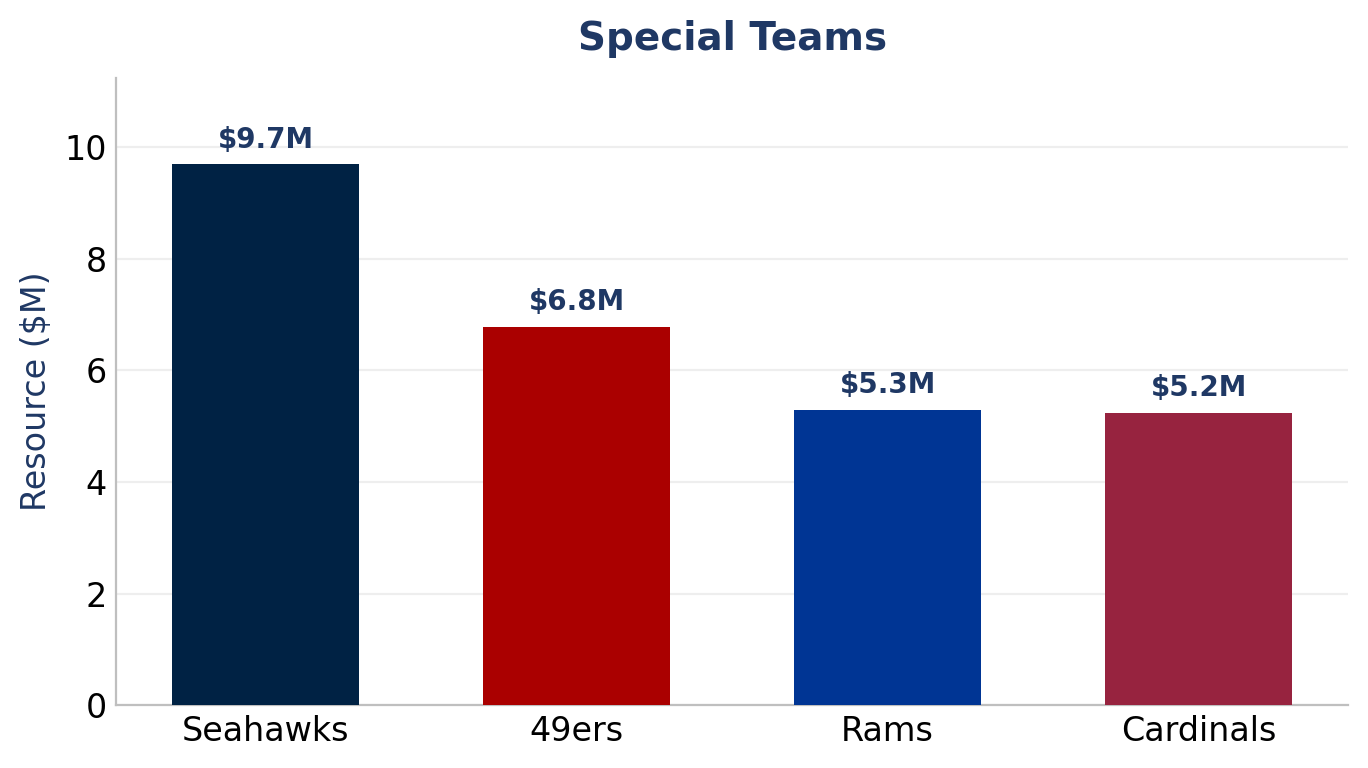
Seattle tops the division, and for once the leader pays both specialists, kicker Jason Myers and punter Michael Dickson. In most divisions so far the leader has paid a premium for a kicker, with Chicago the exception, leading the North on a punter. Seattle is the first to pay both a solid veteran salary.
The NFC From A Distance
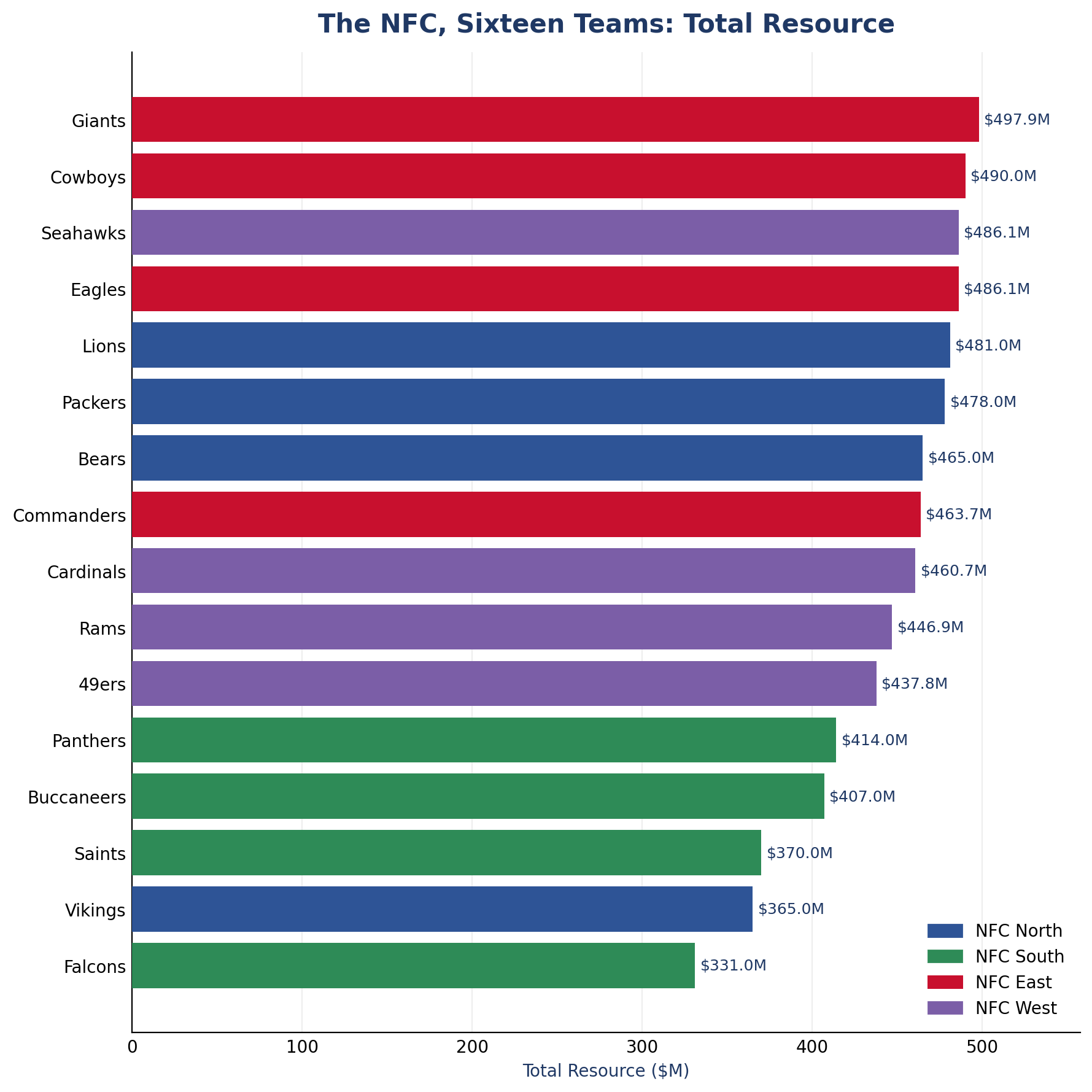
The Seahawks are exactly where you would expect the defending Super Bowl champions. But for how good the NFC West is perceived, they aren’t showing it in roster investments. But the ROI this division gets out of coaching (three of the top 10 head coaches in the NFL reside here in Sean McVay, Kyle Shanahan and Mike Macdonald) is significant.
In addition, many of the teams are getting incredible value out of specific on-field investments. Cardinals tight end Trey McBride is due just $11 million this year. Similarly, 49ers running back Christian McCaffrey is due just $12.5 million this year. And as a former fifth-round pick still on his rookie contract, the Rams are getting an exponential return on Puka Nacua.
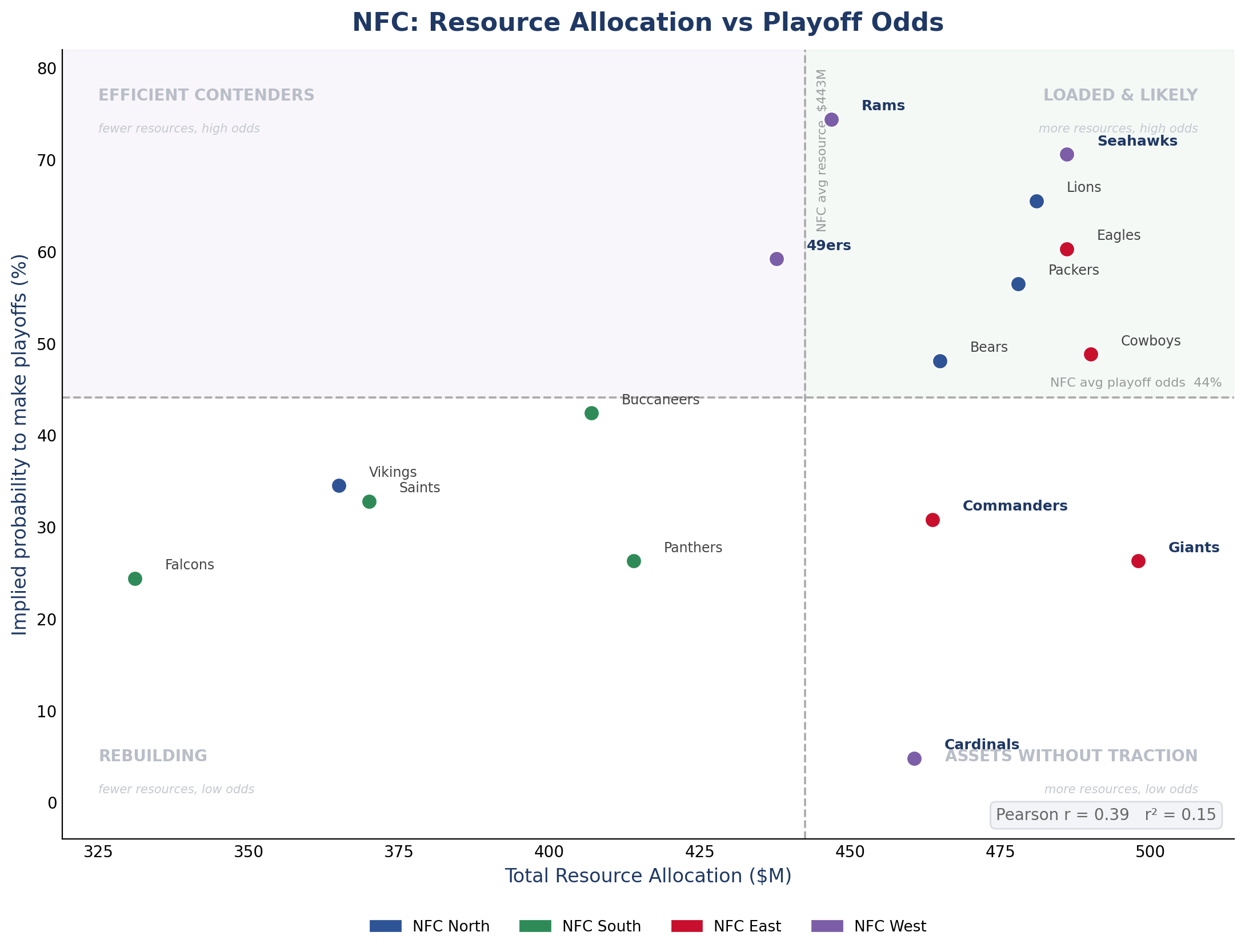
In a league with a closed loop salary cap system like the NFL, resource allocation is a big factor in team competitiveness. But the NFC West is showing that it isn’t the only factor. And ancillary investments - a smart front office/scouting department, coaching - can work like a force multiplier to the roster just like Myles Garrett acts as a force multiplier on the field.
But directionally, the asset allocation chart follows logically with perceptions of team quality or outlook.
Methodology Note
The 53-man rosters are projected from Ourlads depth charts. Rookie pick values are from my proprietary 2026-normalized draft pick value model, annualized over four years. Cash figures are from Spotrac’s 2026 cash tables and reflect real money paid in the year, including signing bonuses, which is why a freshly signed rookie can spike a position group for a single season. UDFAs and players on cap-minimum vet deals are valued at their actual 2026 cash. Players who have signed extensions beyond their original rookie deal are treated as veterans, using cash, not as rookies.
Position groups: QB, RB, WR, TE, OL, DL (IDL + EDGE combined), LB, SEC (CB + S combined), and ST (K, P, LS). Arizona and Seattle run 3-4 base fronts, so edge rushers nominally listed as outside linebackers are counted as EDGE within the defensive line, not as off-ball linebackers, which keeps the front and the linebacker numbers comparable across schemes.
No positional adjustments are applied to pick values. A running back taken at the top of the first round carries the same resource value as a quarterback taken there. This is a deliberate choice consistent with the goal of measuring resource commitment, not expected return.
What’s Next?
The NFC is finished. Next week I cross over to the AFC North, then on to the South, East, and West to close out the league. At the end of the series, I will pull back for a league-wide look and hunt for the patterns the contenders keep repeating. Four divisions in, the NFC West gave us the cleanest version of the question the whole project keeps circling. It is not only about who commits the most. It is about who commits it now, who commits it later, and which of them reads the moment right.
It is not only about who commits the most. It is about who commits it now, who commits it later, and which of them reads the moment right.